Thursday, August 7, 2014

Watch and Pray

Take ye heed, watch and pray: for ye know not when the time is.
For the Son of man is as a man taking a far journey, who left his house, and gave authority to his servants, and to every man his work, and commanded the porter to watch...
And what I say unto you I say unto all, Watch. --Mark 13:33-34,37
 
What does it mean to watch and pray?
I have a story to answer that question.
 
One day, a woman was working in her yard. It was simple work, trimming bushes and plucking upstart weeds from the rocks. She wandered in and out of the garage, puttering, and as she did, she noticed a bag of bird feed that was not quite empty. Rarely did she check the feeder this time of year. After all, bird food grew everywhere, right?  Still, pouring the remainder into the bird feeder would free up space on the garage shelf, so she took it out, stood on tip toes to wrestle the feeder down and filled it to the brim.
 
The next morning, the same woman sat looking out the window. She was praying, sort of. Mostly, she was just sitting, drinking coffee, and "being" with her God. As she stared not-quite blankly, she saw a beautiful cardinal land on the perch of the newly filled birdfeeder. The rising morning light enflamed his feathers as he delicately nipped at the birdseed.  As she watched, God turned the golden light into transcendent illumination. "All the weeks you left that feeder empty, and no birds came to feed. Why should they visit? But look here! The very day after you fill it, they begin to return." And she felt tears prick her eyes, because she'd been praying about her larger purpose. She'd been confused about the balance of productivity in her life as she sought to bless those around her. Fill the feeder. Give the birds a reason to come. Such an elegant answer.
 
Any other day, she would have looked and seen a pretty bird on a beautiful morning as it fed at a birdfeeder. But that day, that one day she received something different, something needful: a live sermon directly from God. Just for her. Just for then.
 
She received it because she watched and prayed.

Saturday, May 31, 2014

Tools for Prayer: Protestant Prayer Beads (Part II)


Bead prayers have been so much a part of the history of Christian prayer that even the word “bead” derives from “bede,” an Anglo-Saxon word meaning “prayer.” The age of Calvinism led to an abandonment of bead praying for most Protestants, but the practice is regaining popularity.
The following bead prayer is taken from a set of prayers organized around the appointed Scripture readings for the church year as given in the Episcopal Book of Common Prayer. Anglican prayer beads like these consist of a cross and 33 beads—31 beads forming a circle and one large bead and a cross outside that circle.  The smaller beads are arranged in groups of 7, called weeks, and four larger beads, called cruciform beads because they form an invisible cross. The four cruciform beads separate these weeks. Directly above the cross is the invitatory bead, which serves as a call to worship as you enter the beads’ prayer circle.
To pray with beads, you start at the cross, holding it in your hand and acknowledging God’s presence. Then you move on the invitatory bead, followed by the first cruciform bead, and them the first set of weeks. On the weeks beads, you will pray the same verse repetitively. It is in the reciting of the weeks that many people grow uneasy, recalling Christ’s warning about prayers that contain vain repetitions. (Matt. 6:7.) For those who pray with beads, however, the problem is not in the repetition but in the vain, or useless, repetition. “The first thing to remember is that God is not impressed by marathon mumbling. But praying with beads in a deliberate and meditative way invites the kind of focused, intentional praying that God honors. The practice of using beads illuminates the fundamental truth that prayer cannot be rushed…Similarly, reading and truly absorbing Scripture takes time…Praying these verses from bead to bead can make us newly aware of their meaning.” (Praying with Beads, p.xii-xiii.)
After praying through the weeks, you leave the circle, praying the last cruciform bead, then reciting the Lord’s prayer as you leave the bead circle and the closing prayer as you hold the cross once more. Feel free to tailor the prayers to your own sense of divine leading. For instance, you may wish to pray for various people with each bead as you pray the weeks. Or you may focus on a different word or image in the verse through each week of the circle.
As we close a week of focusing on mindfulness, a look at bead-praying is appropriate, for in is in the mindfulness that a person is able to steep in the language of a repeated prayer or verse. But the benefits of the focus and the simplicity are great!


Tuesday, May 20, 2014

Tools for Prayer: Protestant Prayer Beads (Part I)

Most people in the Christian faith are familiar with the Catholic rosary beads but are not necessarily aware of their Protestant counterpart. In a later post, we will look at the functional aspects of using such a prayer tool, but today we'll just do an introductory exploration of prayer beads.

"Many different religions use beads as a tool for prayer, and Catholics have a rosary. Consider creating a chain of beads that you can use as a physical tool as you pray throughout the day. Prayer beads aren't magic, but they can help cure some minor cases of ADD. For instance, create a chain of different-sized beads (or different-colored or different textured beads) for various prayers. You might have a large bead for the Lord's Prayer. You might have seven rough beads for praying against the seven deadly sins...and nine...for the fruit of the Spirit." --Common Prayer A Liturgy for Ordinary Radicals

Almost any craft or hobby store has started kits for the novice in beadwork, and many also have a variety of beads from which to choose, so you can thoughtfully personalize your set of prayer beads.
I use mine for a variety of prayer practices: to pray the Psalms as they are given in the book, Praying with Beads; to lift prayers for spiritual direction clients and fellow members of my directors cohort; and currently, I am considering crafting the precepts of my ministry into bead prayer form.

What is the point of using beads for these prayers?

For one thing, the tactile element helps keep the focus on the prayer. For another, the repetitiveness of some prayers--like the ones from the Psalms--helps the one praying to go deeply into a verse, more so than a simple glancing read  provides. To turn a passage into a prayer, the multiple readings offer opportunities to transform the text into a prayer of the heart. What's more, when praying over a list of people or needs, touching each bead individually requires a pause, a singular focus on that one part in the series--something easily missed when prayer involves reciting alone. It is not so for everyone, but for those of us who are distractible, prayer beads can be a beneficial tool.

A prayer rope is a similar way of employing this sort of prayer aid, and if your inclination toward a creative practice includes handwork, here is a nice tutorial for creating your own prayer rope.


Claiborne, Shane. Common Prayer A Liturgy for Ordinary Radicals. Grand Rapids, MI: Zondervan,  2010.

Tuesday, April 29, 2014

The Faith of a Child

But Jesus called them unto him, and said, Suffer little children to come unto me, and forbid them not: for of such is the kingdom of God.
--Luke 18:16
 
waiting for service to begin

 Easter Sunday came bright and beautiful to my town this year. The service was everything I'd hope an Easter service to be. But for me, the highlight of Easter Sunday came at the end of the service when--as a member of the prayer team--I had the privilege of praying with a young lady who responded to the altar call.
 
Her parents brought her forward, along with her four-year-old brother. She was six herself, something I learned as I knelt down to engage her face-to-face. I asked her name and her age, and that was when the little miracle happened--the little miracle that seemed so natural to her that she didn't even take note of it, and so neither did I, although I continue to ponder the wonder of it in my heart.
 
"What's your name?" I asked her.
"A--," she answered.
"And how old are you, A--?"
"I'm six and a half."
I smiled. "You know, I was just about your age when I invited Jesus into my heart, too," I commented.
"Yes, you were five," she said matter-of-factly.
And there it was.
She knew what she couldn't possibly know, but wasn't the least bit surprised at knowing it.
Such is the way of children.
So we prayed for her heart and honored this moment when she purposely invited Christ to make a home there.
Then, her little brother tapped me on the shoulder.  He wanted a prayer, too. He wasn't quite sure why. Not until I saw this picture did I realize she had her hand on his little head. Some part of her--probably the same part that perceived and communed with my own childhood moment of re-creation-- that part knew to pass on what she'd received only moments prior herself, and to pass it on in the only way she knew how...with a touch and a prayer.


Wednesday, April 16, 2014

Designing an Altar Space

Our relentless human search for new ways of being and relating, our dreams of beauty, our longings for mercy and justice, these are exercises of the imagination.
Wendy Wright
 
Sometimes discerning our deeper soul movements requires us to move out of the mode of language and logic and into a more wordless form of expression. Christine Valters Paintner in her book, Awakening the Creative Spirit, offers many exercises aimed at helping a person explore these soul movements.

One of the exercises she offers her spiritual direction clients is mini-altar design.


To use this visual art exercise, Paintner advises:
"Collect a set of figurative symbols or small statues and place them on a tray. Invite directees to create an altar space when they arrive to a session with the symbols which are resonating with them that day. Begin by talking about their selections."


I used this opening exercise with several clients myself and found they all had differing inspiration for the use of each element in their altar space, despite the commonality of the elements.


They also found the placement of the objects in relation to each other and in relation to the overall space likewise added significance to their altars.


One of the beauties of accessing the visual arts this way is that no particular skill or talent is required to reap its benefits. This is a method anyone can use to move into a time of prayer and reflection. It does not need to be complicated. You may choose to use symbols from nature, items that link to scriptural symbolism for you, or anything else that expresses "where you are" with God right now. You could do this with a small group or even alone. If doing the activity with a group or a soul companion, describe your choices and their placement. Explain the significance of each piece and how it defines an altar space between you and God right now. If doing this alone, spend a few moments in prayer after crafting the space. Describe to God why this particular altar space is your way of offering Him hospitality in your heart.
 
 
Paintner, Christine. Awakening the Creative Spirit, Bringing the Arts to Spiritual Direction. New York: Morehouse Publishing. 2010. p. 78


Monday, April 7, 2014

Sacrifice, the Ultimate Offering of Grace

...not to be forgotten: husband/father at whom we all smile!
 
Family.

The zone of life where we learn much about joy and about sacrifice especially where these relate to our hearts' deepest loves. We understand intellectually ideas like the death and resurrection of Christ for the sake of restoring our union with Him, but sometimes a human story helps us identify more deeply with that pinnacle moment in the history of the Church, making it more accessible for us on a human-heart level.

This is just such a story. It comes from the "Author Q & A Section" of Chris Cleave's novel, Little Bee.

In doing research for the book, did you come across any facts or stories of particular importance to you that did not make it into the final draft?
Yes, here's the true story that inspired me to write Little Bee. In 2011, an Angolan man named Manuel Bravo fled to England and claimed asylum on the grounds that he and his family would be persecuted and killed if they were returned to Angola. He lived in a state of uncertainty  for four years pending a decision on his application. Then, without warning, in September 2005, Manuel Bravo and his thirteen-year-old son were seized in a dawn raid and interred at an Immigration Removal Centre in southern England. They were told that they would be forcibly deported to Angola the next morning. That night, Manuel Bravo took his own life by hanging himself in a stairwell. His son was awakened in his cell and told the news. What had happened was that Manuel Bravo, aware of a rule under which unaccompanied minors cannot be deported from the UK, had taken his own life in order to save the life of his son. His last words to his child were: "Be brave. Work hard. Do well at school."
As Holy Week approaches, we might find that considering a contemporary story of sacrifice helps refresh the age-old story of the ultimate sacrifice Christ made for us. When we revisit The Story not so much in the "blockbuster" big screen form, not in the children's church cartoon form, but in the "Whoa! Can I relate to this at all?" form, then we begin to touch the real mystery of transformation offered to us through this great act of sacrifice. Not only might we--through near first-hand identifiers--turn and attempt to understand our own cross-bearing as Christ-followers, but we might also reflect afresh on our place on the other side of the equation: as recipients of that poignant, ultimate sacrifice. We might ponder anew our receptiveness to such a gift: when everything that can be poured out is poured out until there is nothing left but faith, hope and love to explain the action.

Can I accept something so wildly wonderful? Can I really accept it? Does every righteous thing I do now spring from gratitude for this life that was given to me through that sacrifice? Or, are my efforts rather an attempt to diminish its magnitude, bringing it down to a level that is on the top edge of comprehendible for me? Am I trying to prove--after the fact--that I was worth it after all. Just look at me now, if you doubt!

No. In The Story, we, too, are merely refugees in grave danger; and we have only that to claim as our stature in "deserving" the ultimate sacrifice. We are the creation of the Father, and this alone explains His deep desire to not only plant but also preserve life in us. May we embrace the beauty of that grace more fully with every passing Easter.

(excerpt from Christ Cleave's Little Bee, Simon and Schuster publishers, New York, NY.)


Wednesday, April 2, 2014

Faithfulness and Its Effect on Conscience

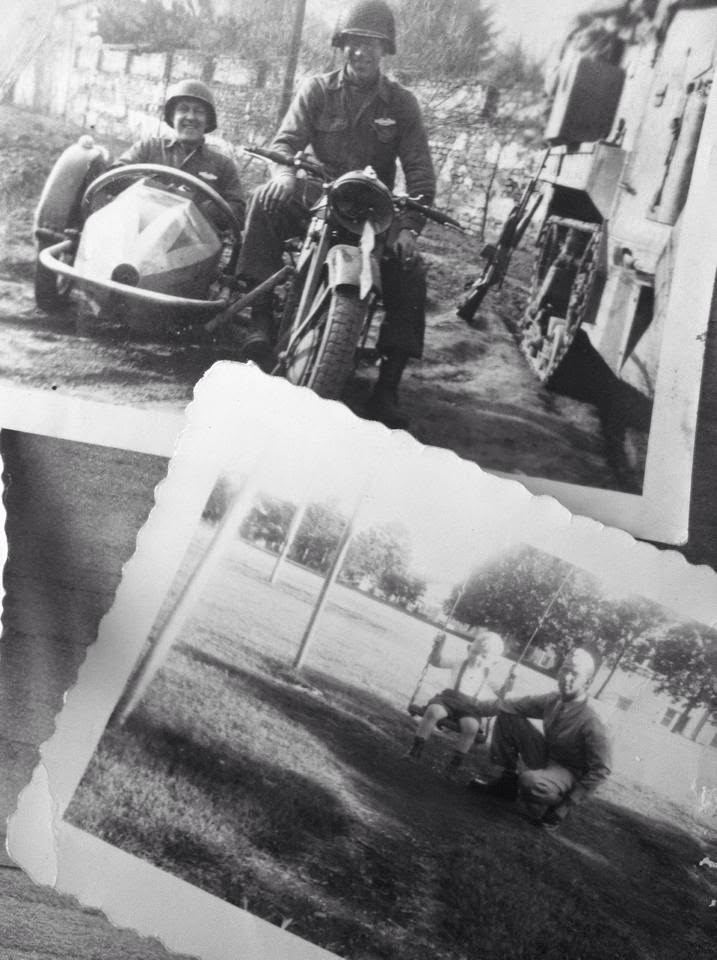
(Photos in illustration are from my own grandfather's personal collection of WW II pictures...)

Robert Smith gives a poignant autobiographical glimpse on the topic of risking much for the sake of conscience in his book A Quaker Book of Wisdom.  Quakers, he says, "live to the point," which seemed simple enough to him as a child. As a child, he presumed "religion would provide me with all the guidelines I needed to become the sort of man I hoped to be." But as WW II loomed,  his dedication to the Quaker tenet of conscientious objection to war became problematic.
"The Quaker dictate of nonviolence was reinforced through every encounter in my close, warm world. It was a message I had been absorbing all my life--easy to learn and easy to believe. The directive...to love your fellowman and do good.  And in 1936 this seemed, without question, to preclude shooting rifles and tossing grenades.

"Eight years later I was a private in an infantry company, marching through the snowy Belgian woods toward the Battle of the Bulge."

All of us eventually find we face that moment where "conscience meets relentless reality." In that place, we must find and express our true faithfulness. For Smith, despite his Quaker upbringing, that meeting of conscience and reality revealed "what was becoming increasingly obvious to me...that Hitler was a brutal murderer who must be opposed, and that fascism was the closest thing to an ocean of darkness that I was likely to encounter in this life."

How did he come to this place of decision? He asked himself and God the hard questions most hesitate to ask: "Is there that of God in every man? Can you maintain that ideal in a world dominated by barbaric cruelty? Does keeping humanity alive take precedence over belief in nonviolence?"

And life experience refined externally what was taking form for him internally.

"One morning a group of us decided to check out the town's bombed-out church. Why did we even bother to go in? As we stepped over, around, and through the debris, we noticed to our surprise that the organ appeared to be intact. A guy said he'd--what the hell--give it a try. Pushing aside a mess of debris, he began to pump the pedals and hit the keys. And some notes began to come out, notes that sounded like Back. And it no longer mattered that everything around was broken, that death was only two days behind us. Here we were, a ragged group of men of differing religious backgrounds who were suddenly embraced by the sensation that something like a divinity was right there with us. Soothing and protecting us. Better than a hot shower or a hot meal. Better than a night without guard duty. It was the sound of eternal life."

In the end, he discovered how best to live his own life's story, with its truths deeply rooted in the soil of a faith-oriented risk for the sake of conscience. "More than half of the draft-eligible Quaker men in the US served in WW II, inspired by the clear moral choices of this conflict. It was a higher percentage than in any previous war. I believe wholeheartedly that the Quakers who were conscientious objectors did the right thing. They were keeping alive a precious ideal--affirming the role of peacemaker and the place of nonviolence in human affairs. Those who went to war did the right thing, too...listening to that still, small voice of God within you, and doing your best to follow the path of truth...No one but God can ever judge the choices we make."

Smith, Robert L. A Quaker Book of Wisdom. New York: Eagle Brook, 1998. pp. 64-77.