Tuesday, April 29, 2014

The Faith of a Child

But Jesus called them unto him, and said, Suffer little children to come unto me, and forbid them not: for of such is the kingdom of God.
--Luke 18:16
 
waiting for service to begin

 Easter Sunday came bright and beautiful to my town this year. The service was everything I'd hope an Easter service to be. But for me, the highlight of Easter Sunday came at the end of the service when--as a member of the prayer team--I had the privilege of praying with a young lady who responded to the altar call.
 
Her parents brought her forward, along with her four-year-old brother. She was six herself, something I learned as I knelt down to engage her face-to-face. I asked her name and her age, and that was when the little miracle happened--the little miracle that seemed so natural to her that she didn't even take note of it, and so neither did I, although I continue to ponder the wonder of it in my heart.
 
"What's your name?" I asked her.
"A--," she answered.
"And how old are you, A--?"
"I'm six and a half."
I smiled. "You know, I was just about your age when I invited Jesus into my heart, too," I commented.
"Yes, you were five," she said matter-of-factly.
And there it was.
She knew what she couldn't possibly know, but wasn't the least bit surprised at knowing it.
Such is the way of children.
So we prayed for her heart and honored this moment when she purposely invited Christ to make a home there.
Then, her little brother tapped me on the shoulder.  He wanted a prayer, too. He wasn't quite sure why. Not until I saw this picture did I realize she had her hand on his little head. Some part of her--probably the same part that perceived and communed with my own childhood moment of re-creation-- that part knew to pass on what she'd received only moments prior herself, and to pass it on in the only way she knew how...with a touch and a prayer.


Wednesday, April 16, 2014

Designing an Altar Space

Our relentless human search for new ways of being and relating, our dreams of beauty, our longings for mercy and justice, these are exercises of the imagination.
Wendy Wright
 
Sometimes discerning our deeper soul movements requires us to move out of the mode of language and logic and into a more wordless form of expression. Christine Valters Paintner in her book, Awakening the Creative Spirit, offers many exercises aimed at helping a person explore these soul movements.

One of the exercises she offers her spiritual direction clients is mini-altar design.


To use this visual art exercise, Paintner advises:
"Collect a set of figurative symbols or small statues and place them on a tray. Invite directees to create an altar space when they arrive to a session with the symbols which are resonating with them that day. Begin by talking about their selections."


I used this opening exercise with several clients myself and found they all had differing inspiration for the use of each element in their altar space, despite the commonality of the elements.


They also found the placement of the objects in relation to each other and in relation to the overall space likewise added significance to their altars.


One of the beauties of accessing the visual arts this way is that no particular skill or talent is required to reap its benefits. This is a method anyone can use to move into a time of prayer and reflection. It does not need to be complicated. You may choose to use symbols from nature, items that link to scriptural symbolism for you, or anything else that expresses "where you are" with God right now. You could do this with a small group or even alone. If doing the activity with a group or a soul companion, describe your choices and their placement. Explain the significance of each piece and how it defines an altar space between you and God right now. If doing this alone, spend a few moments in prayer after crafting the space. Describe to God why this particular altar space is your way of offering Him hospitality in your heart.
 
 
Paintner, Christine. Awakening the Creative Spirit, Bringing the Arts to Spiritual Direction. New York: Morehouse Publishing. 2010. p. 78


Monday, April 7, 2014

Sacrifice, the Ultimate Offering of Grace

...not to be forgotten: husband/father at whom we all smile!
 
Family.

The zone of life where we learn much about joy and about sacrifice especially where these relate to our hearts' deepest loves. We understand intellectually ideas like the death and resurrection of Christ for the sake of restoring our union with Him, but sometimes a human story helps us identify more deeply with that pinnacle moment in the history of the Church, making it more accessible for us on a human-heart level.

This is just such a story. It comes from the "Author Q & A Section" of Chris Cleave's novel, Little Bee.

In doing research for the book, did you come across any facts or stories of particular importance to you that did not make it into the final draft?
Yes, here's the true story that inspired me to write Little Bee. In 2011, an Angolan man named Manuel Bravo fled to England and claimed asylum on the grounds that he and his family would be persecuted and killed if they were returned to Angola. He lived in a state of uncertainty  for four years pending a decision on his application. Then, without warning, in September 2005, Manuel Bravo and his thirteen-year-old son were seized in a dawn raid and interred at an Immigration Removal Centre in southern England. They were told that they would be forcibly deported to Angola the next morning. That night, Manuel Bravo took his own life by hanging himself in a stairwell. His son was awakened in his cell and told the news. What had happened was that Manuel Bravo, aware of a rule under which unaccompanied minors cannot be deported from the UK, had taken his own life in order to save the life of his son. His last words to his child were: "Be brave. Work hard. Do well at school."
As Holy Week approaches, we might find that considering a contemporary story of sacrifice helps refresh the age-old story of the ultimate sacrifice Christ made for us. When we revisit The Story not so much in the "blockbuster" big screen form, not in the children's church cartoon form, but in the "Whoa! Can I relate to this at all?" form, then we begin to touch the real mystery of transformation offered to us through this great act of sacrifice. Not only might we--through near first-hand identifiers--turn and attempt to understand our own cross-bearing as Christ-followers, but we might also reflect afresh on our place on the other side of the equation: as recipients of that poignant, ultimate sacrifice. We might ponder anew our receptiveness to such a gift: when everything that can be poured out is poured out until there is nothing left but faith, hope and love to explain the action.

Can I accept something so wildly wonderful? Can I really accept it? Does every righteous thing I do now spring from gratitude for this life that was given to me through that sacrifice? Or, are my efforts rather an attempt to diminish its magnitude, bringing it down to a level that is on the top edge of comprehendible for me? Am I trying to prove--after the fact--that I was worth it after all. Just look at me now, if you doubt!

No. In The Story, we, too, are merely refugees in grave danger; and we have only that to claim as our stature in "deserving" the ultimate sacrifice. We are the creation of the Father, and this alone explains His deep desire to not only plant but also preserve life in us. May we embrace the beauty of that grace more fully with every passing Easter.

(excerpt from Christ Cleave's Little Bee, Simon and Schuster publishers, New York, NY.)


Wednesday, April 2, 2014

Faithfulness and Its Effect on Conscience

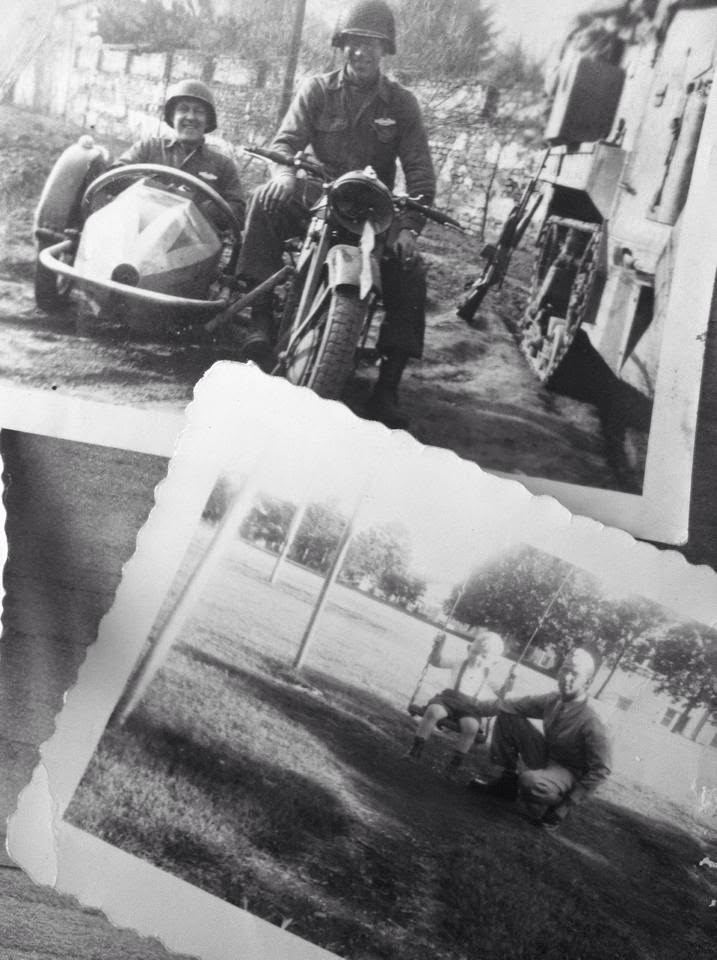
(Photos in illustration are from my own grandfather's personal collection of WW II pictures...)

Robert Smith gives a poignant autobiographical glimpse on the topic of risking much for the sake of conscience in his book A Quaker Book of Wisdom.  Quakers, he says, "live to the point," which seemed simple enough to him as a child. As a child, he presumed "religion would provide me with all the guidelines I needed to become the sort of man I hoped to be." But as WW II loomed,  his dedication to the Quaker tenet of conscientious objection to war became problematic.
"The Quaker dictate of nonviolence was reinforced through every encounter in my close, warm world. It was a message I had been absorbing all my life--easy to learn and easy to believe. The directive...to love your fellowman and do good.  And in 1936 this seemed, without question, to preclude shooting rifles and tossing grenades.

"Eight years later I was a private in an infantry company, marching through the snowy Belgian woods toward the Battle of the Bulge."

All of us eventually find we face that moment where "conscience meets relentless reality." In that place, we must find and express our true faithfulness. For Smith, despite his Quaker upbringing, that meeting of conscience and reality revealed "what was becoming increasingly obvious to me...that Hitler was a brutal murderer who must be opposed, and that fascism was the closest thing to an ocean of darkness that I was likely to encounter in this life."

How did he come to this place of decision? He asked himself and God the hard questions most hesitate to ask: "Is there that of God in every man? Can you maintain that ideal in a world dominated by barbaric cruelty? Does keeping humanity alive take precedence over belief in nonviolence?"

And life experience refined externally what was taking form for him internally.

"One morning a group of us decided to check out the town's bombed-out church. Why did we even bother to go in? As we stepped over, around, and through the debris, we noticed to our surprise that the organ appeared to be intact. A guy said he'd--what the hell--give it a try. Pushing aside a mess of debris, he began to pump the pedals and hit the keys. And some notes began to come out, notes that sounded like Back. And it no longer mattered that everything around was broken, that death was only two days behind us. Here we were, a ragged group of men of differing religious backgrounds who were suddenly embraced by the sensation that something like a divinity was right there with us. Soothing and protecting us. Better than a hot shower or a hot meal. Better than a night without guard duty. It was the sound of eternal life."

In the end, he discovered how best to live his own life's story, with its truths deeply rooted in the soil of a faith-oriented risk for the sake of conscience. "More than half of the draft-eligible Quaker men in the US served in WW II, inspired by the clear moral choices of this conflict. It was a higher percentage than in any previous war. I believe wholeheartedly that the Quakers who were conscientious objectors did the right thing. They were keeping alive a precious ideal--affirming the role of peacemaker and the place of nonviolence in human affairs. Those who went to war did the right thing, too...listening to that still, small voice of God within you, and doing your best to follow the path of truth...No one but God can ever judge the choices we make."

Smith, Robert L. A Quaker Book of Wisdom. New York: Eagle Brook, 1998. pp. 64-77.

Saturday, March 29, 2014

Where Do I Find Myself Most Happy?


"Paths are made by walking."
  --Antonio Machado

Many, and particularly those who don't feel they have a creative bent, avoid considering their artistic side as a source of inner gladness. Our achievement and outcome-based society rarely applauds the process as highly as the product in terms of the satisfaction it renders; but to clasp artistic creativity as a spiritual practice means doing exactly that. The act of creating IS the way of exploring the image of God that graces our humanness and helps us commune with a specific aspect of His joy
.
"Art-making is somehow all at once a journey, a communication, a modality, a healing, and a prayer," says Betsy Beckman in Awakening the Creative Spirit. The beauty of it is, none of these attributes of art-making depend on the expertise of the artist nor on the quality of what is produced.

But for art to mediate anything sacred to us, we must make a place for it to have full access to our undivided attention.  Lana has done just that, and tells us about the artist's retreat she has right in her own backyard:


"My cottage was built for me by my husband so I had a place to be able to leave my project on the work bench instead of having to clear everything from the dinning room table every night and store my supplies in the garage.


 I make jewelry, scrapbook, paint, do floral arrangements, make soap and candles, paint birdhouses and ceramics in the cottage. I also keep my some of my candy and cake decorating supplies out there when I'm not using them. My sewing, quilting and embroidery supplies are out there but I have been keeping my Bernina in the house.


I cleared a corner a couple of years ago for my daughter to have her own work area. She is into Perler beads and does intricate designs.
Having the cottage for my crafty creativity is a huge blessing for me. I have my office for writing and computer creativity but that is heavily impacted by running the household from the same office. My cottage is purely creative.


It's like a personal retreat and even though it's just behind the house in the back yard getting out there is both very easy and very difficult at the same time. All I have to do is walk out the back door, through the rose garden and there I am. But making the time to stop everything else and get out there.... well that's much more difficult."


Even if a full-scale cottage is not a possibility for you, might there be a place where you can be creatively attentive, communing with God as creator to Creator?  For some, this communing can be the first appreciable step toward attending to God in an otherwise dry, sad season.
 
And let the beauty of the LORD our God be upon us: and establish thou the work of our hands upon us; yea, the work of our hands establish thou it. --Psalm 90:17

Thursday, March 20, 2014

Fair Weather Friends

The need does not define the call, the call defines the need.

A pithy little saying I once read that makes more and more sense as the years roll along, because nothing seems to kindle the fires of burnout faster than a call that springs more from observed need than it does from focused intention to meet Christ's interests in the Church and the world.

One of the spiritual formation practices I find most appealing is the imaginative reading of scripture. Such a reading refreshes passages that I've read so many times I find my attentiveness waning. I have gleaned all I can from informational reading--I master the text--and am ready to engage with formational reading--the text masters me. (Thank you, Alice Fryling for that easy definition of comparative scripture study models. More on her materials in the link below.)

Allowing your imaginations to touch your Gospel reading  is nothing more mystical than seeing yourself in the story. Reading the story as a participant, you determine who you are in the scenario, and notice how the environment affects your senses, who interacts with you and how you respond to the progress of the plot. In essence, you engage the passage at a personal level.

Recently, I felt God invite me to walk the full range of discipleship, serving Christ in this manner. Here is a review of my experience.


And he told his disciples to have a boat ready for him because of the crowd, lest they should crush him; for he had healed many, so that all who had diseases pressed upon him to touch him.
--Mark 3:9-10 RSV
 
 I feel like the body guard of a rock star when he gives the urgent command--have a boat ready. As the other disciples and I hurry to secure a boat--his escape route from the dangerously pressing fans--we look at each other and chuckle nervously, we shake our heads in amazement at what life has brought us so quickly. Who would have guessed we would be the ones to do this sort of thing??
 
And he said to them, "Come away by yourselves to a lonely place, and rest a while." For many were coming and going, and they had no leisure even to eat.
And they went away in the boat to a lonely place by themselves.
Now many saw them going, and knew them, and they ran there on foot from all the towns, and got there ahead of them.
As he went ashore he saw a great throng, and he had compassion on them, because they were like sheep without a shepherd; and he began to teach them many things.
--Mark 6:31-34
 
The adrenaline rush of the wild days of miracles and healings, the demands of the ever-swarming mass of humanity--these are taking their toll. We have no time for our own most basic needs. Now when we disciples smile at each other, it is a weary smile of compassion sprouting from the soil of our communal exhaustion. He sees our weariness and invites us to rest, but the mobs JUST WON'T QUIT! And neither will he. He's like a machine. How does he do it??
 
...and this is the will of him who sent me, that I should lose nothing of all that he has given me, but raise it up at the last day.
He who eats my flesh and drinks my blood abides in me, and I in him.
Many of his disciples, when they heard it, said, "This is a hard saying; who can listen to it?"
After this many of his disciples drew back and no longer went about with him.
Jesus said to the twelve, "Do you also wish to go away?"
--John 6:39, 56, 60, 66-67
 
Enough with the parables already! The healings and miracles bring people in droves; but then he starts talking.
At first, the stories scratch a nagging itch in their hearts. Yes! This is so true, they cry.
But later, the stories change. The people are horrified. Can't he see they're not ready for the out-of-this-world weirdness? The followers are leaving, which is a relief in a way, but also a little frightening because they're leaving offended.  Just what have we signed up for here? Why don't these people get it? We get it. It rings true but only because he explains it to us. Why won't he explain it to them? He's maddening. We aren't exactly rocket-scientists, but we get it because he explains himself. Why won't he do that for them??
Then he asks us the question we've all been asking ourselves. We look at each other, and we know the same question haunted us days before he asked it aloud. It's in our eyes when we glance at each other. Are we leaving, too?
What did we sign up for?
 
Simon Peter answered him, "Lord, to whom shall we go? You have the words of eternal life;
and we have believed, and have come to know, that you are the Holy One of God."
--John 6:68-69
 
One by one, our eyes changes. First, Peter's shifted. That wide stare of haunted horror narrowed into a fierce determination. One by one, the rest of us transfigured. We saw each other around this circle as each one made the transition. This marked our knowing each other. Really knew each other. This moment Peter became the one who would define the place where the church would come to life. "You have the words of eternal life." The words. Will  we really let the words that make us uncomfortable drive us away? It's these words that matter, after all. These words measure us.
 
Simon Peter replied, "You are the Christ, the Son of the living God."
And I tell you, you are Peter, and on this rock I will build my church, and the powers of death shall not prevail against it.
--Matthew 16:16, 18

These were the headwaters of the church. Not the day he called us winsomely. Not even the days of miracles and healings, raising of the dead or mountaintop sermons. These all mattered, but the defining spark was in words. Words of revelation. No-matter-what words. Nothing-changes-who-You-are words.  This is when death first lost its sting...and not just for a generation, but for all time. When you asked and we answered that we would not go away.

What do I glean from this way of reading scripture?
I realize that it  is good to occasionally pause and contemplate the season that my serving is experiencing. I'd like to think all our service is like that first flush of thrill and energy that the disciples knew; but if I am honest I know that easy times and hard times will continue throughout all aspects of my life, and to deny the back-and-forth flow is to put myself at risk of either burnout or self-idolization. Neither was God's purpose in creating His church. His light shines in me the brightest, his revelation speech over me is the boldest when I can--in any season--answer like Peter when Christ questions me: "Do you also wish to go away?"


Bonus link: If you're refreshed by this way of reflecting on scripture, you might like joining a spiritual accompaniment small group that makes a practice of reviewing scripture together this way. Here is a good resource for learning more about such groups.


Wednesday, March 12, 2014

There's Hope in the Cross for Me

And when he had called the people unto him with his disciples also, he said unto them, Whosoever will come after me, let him deny himself, and take up his cross, and follow me. Mark 8:34


How in the world do we associate hope with such a command?
How do we not get stuck in the mires of self-denial and sink under a flood of self-pity?
Many of us wince and turn away from such talk of crosses because we know that is precisely what we would do.
The only way  is to search out  the perfect gift that pierces the darkness that swirls around these crosses. But it is not easy because this is, after all, a call to step willingly into the pain of withdrawal as we stop dosing on self-protection and start leaning into trust.
 
Every life lived in God's will has its moments on the peak of transfiguration and in the depth of death to self.  If we make life out to be all power and brilliancy, we grow shallow and useless as comforters of others. We may inspire them with our enthusiasm and assurance--which are good, but we cannot comfort them. More troublesome, we grow blind to our own peculiar needs for control. On the other hand, if we make life out to be all suffering and cost-counting, we grow bitter and exhausted, proving to be equally useless as comforters. Here, too, we may inspire, now with our perseverance, our self-control and our forbearance; but again, we can not comfort.  Likewise, in this perpetual state we grow blind to our own peculiar needs for control. In the balance of seasons we find our usefulness to God, to others and to ourselves. In the transition between our seasons of suffering and joy, we process what we experienced in the fullness of each season. God brings us to connect our story with an ever fuller range of Christ's own story.
 
But often  we perceive the cross of self-denial hopelessly; and by not connecting with the purpose of that cross we might misinterpret what we are being asked to take up in the first place. We end up crucifying the very thing our cross was meant to set free: our true self. It is our false self, the one that believes in the wrong comforts, that agrees with the addictions, that sets its sights on temporary coping and grasps at every sign of strength and power--this is what must die. Christ's true self, his essential self that defined his reason for becoming human--this is what was released by the cross and extended beyond it. Our perception of our own crosses should be just as far-reaching and should definitely be received through discernment. 
 
If we determine to take up our cross to follow him, we must listen closely. The hardest part is recognizing what cross to carry and what hill to climb with it, but the hidden hope that knows something wonderful, something eternal will be set free--this hope gives us the courage to follow Christ.